
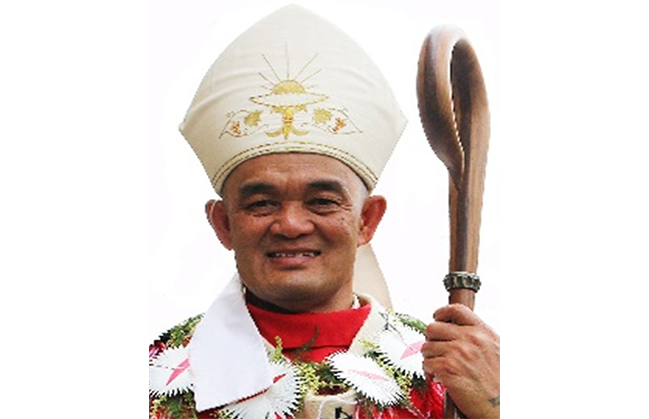
ARCHBISHOP OF SUVA
His Excellency, the Most Reverend
PETER LOY CHONG DD
OFFICE: Nicholas House
35 Pratt Street
P. O. Box 109, Suva
Telephone: (679) 330 1955
Fax: (679) 330 1565
Homily for the Twelfth Sunday in Ordinary Time
Archbishop Peter Loy Chong (Rewritten)
In today’s Gospel, Jesus says, “Even the hairs of your head are all counted.” When I read those words, I smile because some of us do not have as many hairs as we once did! For those who still have a full head of hair, give thanks to God. For some of us, the number keeps getting smaller. Yet the message is clear: God knows us completely and cares for us deeply.
Today, I especially want to speak to our young people because the readings contain a beautiful message for you. In the second reading, Saint Paul speaks about two realities.
The first reality is sin and human brokenness. All of us experience weakness. We make mistakes. We fail to do the good we want to do. We hurt others and ourselves. This is part of being human.
But Saint Paul also speaks about a second reality, and this is the Good News: God’s grace is greater than our sin. God’s love is bigger than our failures. God’s mercy is stronger than our weakness.
Yes, sin is real. We go to confession because we know we need forgiveness. Yet Saint Paul reminds us that our mistakes do not have the final word. There is something greater than our sins, and that is the love and forgiveness of God.
This is wonderful news, especially for young people. When we are young, we often make many mistakes. I remember my own teenage years. I made many mistakes too. At that time, the message we often heard was that if we sinned too much, we would end up in hell. I began counting all the wrong things I had done and wondered how I could ever be worthy before God.
What I did not hear enough was the other side of the story: that no sin is greater than God’s mercy. There is no failure so great that God cannot forgive it. Discovering this truth changed my life. It was a profound transformation to believe that God loved me, even when I felt unworthy, and that He loves you in exactly the same way.
This experience is not limited to young people. Every human being goes through it. Whether we are Catholic, Hindu, Muslim, Christian, or belong to no religion at all, we share something in common: we are not perfect. We are broken and incomplete. Like Saint Paul, we often find ourselves saying, “The good I want to do, I do not do, and the evil I want to avoid, I keep on doing.”
We all struggle. We all fall short.
But we also share another truth: we cannot become truly good by our own strength alone. We need God’s grace. Deep within every human heart is a longing for something greater than ourselves. We long for goodness, truth, love, and meaning.
A spiritual writer calls this longing a “holy longing” or a “sacred fire” within us. God created us for Himself, and He has planted goodness within every person. That is why we continually seek to become better and to reach beyond our weaknesses.
The Good News today is that God’s grace is abundant. There is enough for everyone.
In Fijian, grace was once translated with an older word, but a newer translation uses the word “Loma.” This word beautifully expresses God’s love flowing continuously, like a waterfall that never stops. Grace is God’s love constantly pouring out upon us.
That is what God’s grace is: an endless stream of love flowing toward us.
And Saint Paul tells us that when we fail, God’s love does not disappear. In fact, His grace reaches out to us even more. Yes, we are weak. Yes, we make mistakes. Yes, we will probably continue to struggle. But we must never forget that God’s love is overflowing and abundant.
Sometimes people disappoint us. Sometimes we feel unloved, forgotten, or rejected. Yet we must never forget that God loves us always.
This love is a free gift. Jesus showed us that gift by dying on the cross for us. He did not wait until we became perfect before loving us. He loved us while we were still sinners.
Sometimes we think, “I must change first. I must become better before God can love me.” But that is not true. God loves you exactly as you are. Certainly, He calls you to grow and change, but His love for you does not depend on your perfection. Whether you succeed or fail, whether you are strong or weak, God loves you.
Young people, hear this clearly: in God’s eyes, no one is useless. No one is worthless. No one is junk. Every person is precious. Every person has dignity. Every person is loved.
That is the Good News Saint Paul proclaims today.
For parents, grandparents, uncles, aunts, and all adults, this message is also a challenge. We are called to communicate God’s overflowing love to our children and grandchildren.
Our world can be harsh and wounded. We hear heartbreaking stories of abuse, violence, and broken families. In such a world, children need to experience God’s grace through us.
Be patient with them. Encourage them. Speak words of affirmation. Show them kindness and understanding. Let them experience the love of God through your actions.
When children encounter this love in their families and communities, they begin to understand the free gift of God’s grace.
So today, young people, believe that you are deeply loved and precious to God.
And parents, grandparents, and all caregivers, pray that you may become instruments of God’s grace, helping the younger generation experience the hope and love that come from Him.
This is what Jesus means when He tells us not to be afraid. Trust in God. Trust in His abundant love. Trust in His never-ending grace. Trust in the love that flows like a waterfall and never runs dry.
And always place your confidence in that love.
Amen.