Ratu Sir Lala Sukuna and the remaking of iTaukei leadership
The Path of Hope: A Vision for Human Dignity and Prevention
February 25, 2026
Archbishop’s Newsletter
July 29, 2026Ratu Sir Lala Sukuna and the remaking of iTaukei leadership
By Archbishop Peter Loy Chong
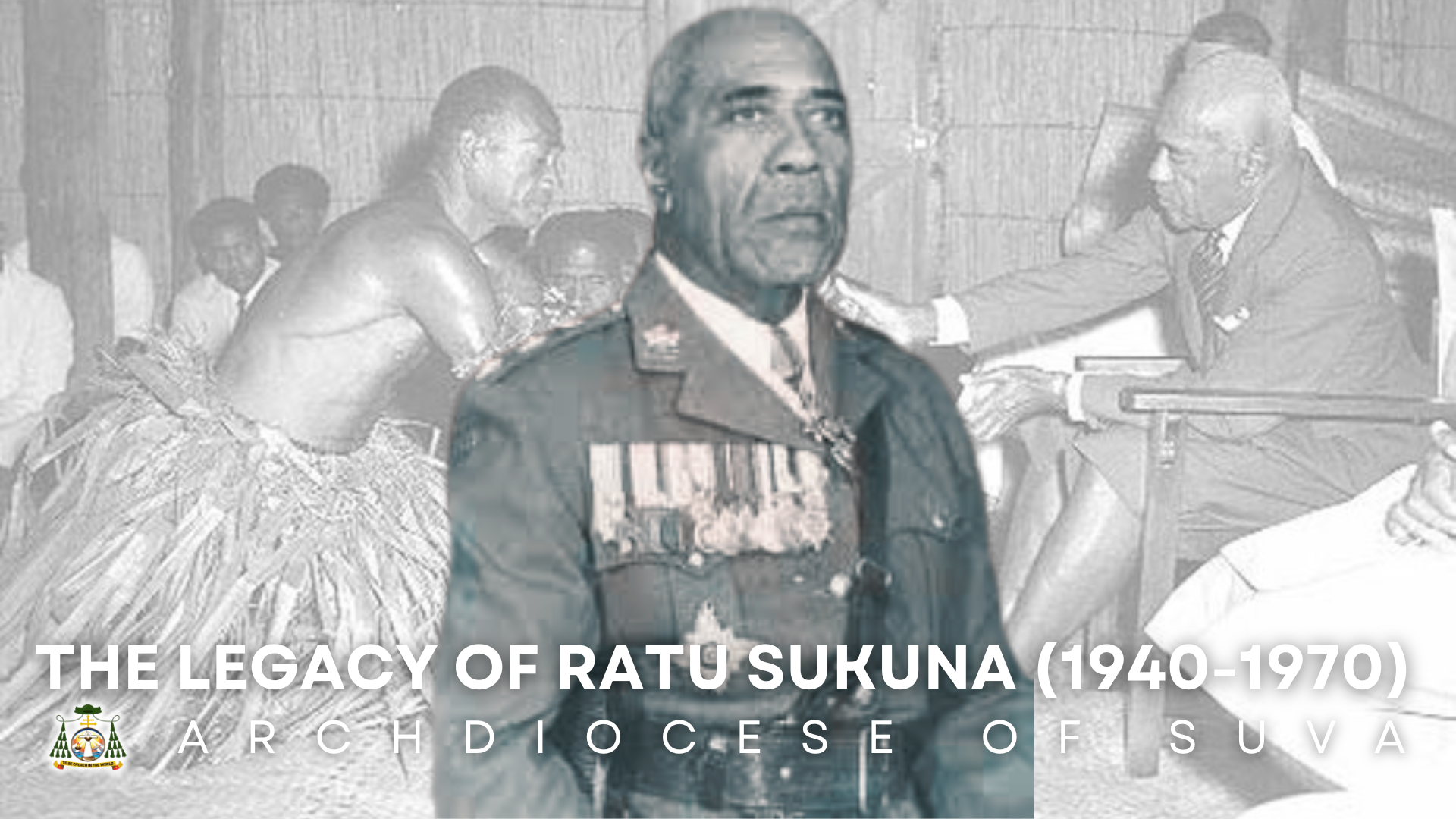
Ratu Sir Lala Sukuna remains one of the towering figures of Fiji’s colonial history—a soldier, scholar and statesman who helped redefine iTaukei leadership during a period of profound change.
Sukuna drew his chiefly status from both his maternal and paternal ancestry. Through his mother, he traced a connection to Ratu Seru Cakobau. Through his father, Ratu Joni Madraiwiwi, and his grandfather, Ratu Mara Kapaiwai, he inherited a place within the Bau chiefly world.
Commonly cited genealogies identify Ratu Mara Kapaiwai as the son of Ratu Vuibureta, a half-brother of Ratu Tanoa Visawaqa, the father of Ratu Seru Cakobau. Sukuna’s chiefly standing therefore came not only through his maternal ancestry but also through significant male-line descent within the Bauan chiefly line. Yet intellect, discipline and vision—not chiefly ancestry alone—ultimately distinguished him.
Sukuna became one of the first Fijians to pursue extensive higher education overseas. He studied first in New Zealand and later at Wadham College, Oxford. Even before he returned to Fiji, he had already lived an exceptional life.
During the First World War, Sukuna served in France with the French Foreign Legion. France awarded him the Médaille Militaire for bravery. In 1921, he qualified as a barrister through the Middle Temple. By then, he ranked among the best-educated and most accomplished Fijians of his generation.
However, he returned to a Fiji undergoing rapid change.
While Sukuna studied overseas, the colonial government reduced the authority of chiefs. Colonial officials argued that chiefs had failed to advance the iTaukei community and that traditional obligations restricted individual progress. The government introduced more direct colonial control, placed Europeans in positions of authority at district and provincial levels, and promoted individual farming as the preferred path to economic development.
By the middle of the 1910s, the government had dismantled much of the earlier Native Administration. Nevertheless, chiefs and local officials continued to exercise considerable influence within villages.
Another major development also transformed Fiji’s social landscape: the end of the indenture system in 1920. The colonial indenture system brought 62,837 Indians to Fiji, and many chose to remain after completing their contracts. Over time, they became central to the colonial economy, particularly to the sugar industry.
Many Indo-Fijian farmers grew sugar cane, rice, cotton and bananas. Indian merchants, professionals and other free migrants further strengthened the community’s economic and social position.
By the early twentieth century, Indians born in Fiji had begun to form a distinct identity. Unlike many members of the indentured generation, they increasingly regarded Fiji, rather than India, as their homeland. They demanded political equality, fair representation and secure access to land. By 1956, the Indo-Fijian population had surpassed the iTaukei population and remained larger until 1987.
Sukuna therefore entered a colony in which Indo-Fijians had gained growing economic and political influence, Europeans claimed responsibility for protecting iTaukei interests, and many iTaukei communities struggled to participate fully in the modern economy.
Sukuna rose to leadership at this decisive moment. In 1943, the colonial government appointed him Secretary for Fijian Affairs. During the mid-1940s, Governor Sir Philip Mitchell reorganised iTaukei administration through a policy often described as neo-indirect rule.
Under the new postwar structure, Sukuna assumed several central leadership responsibilities, including the chairmanship of the Fijian Affairs Board. These roles gave him exceptional influence over iTaukei administration and development.
From this position, Sukuna helped shape the future of iTaukei governance.
He firmly believed that the Fijian Administration and the Bose Vakaturaga could advance the iTaukei people. However, he did not seek a simple return to an earlier colonial system. He wanted these institutions to promote social, economic and political development while protecting the foundations of iTaukei society.
Sukuna approached reform cautiously and conservatively. He believed that colonial officials could not suddenly impose Western democratic ideas upon iTaukei communities. In his view, development had to proceed gradually and respond to local conditions. He supported equality but argued that education, capable leadership and experience in local government must prepare communities to exercise it effectively.
At an administrative conference in 1944, Sukuna outlined three basic principles. First, because agriculture formed the foundation of Fiji’s economy, leaders had to protect the relationship between people and land. Second, they had to prevent the breakdown of iTaukei society. Third, they had to make village life more attractive and sustainable by improving housing, infrastructure and social services.
He also argued that meaningful development required organisation beyond the immediate kinship group, improved access to domestic and overseas markets, greater production of cash crops, and an education system suited to Fiji’s cultural and economic environment.
Sukuna also recognised a central weakness in the system. It depended heavily on chiefs, yet many chiefs lacked the education and administrative experience required for modern leadership. To address this problem, he promoted higher education for both chiefs and commoners.
Ratu Sir Kamisese Mara benefited from this vision and later became independent Fiji’s first Prime Minister.
Ratu Sukuna also pursued administrative reform. He helped restructure the Fijian Administration, reduced the number of provinces from 19 to 14 and consolidated 186 districts into 74. Ratu Sukuna promoted larger villages that could gain better access to resources, infrastructure and public services. He also opened more administrative positions to iTaukei commoners.
Despite these reforms, progress remained limited. Many changes focused on the internal structure of the Fijian Administration rather than wider participation in Fiji’s economy and political system. The iTaukei community therefore did not advance as quickly as Sukuna had hoped.
His commitment to communal life and chiefly leadership also encouraged the administration to insulate iTaukei communities from some of the economic and political changes taking place around them. Although this approach protected land, identity and social structures, it also limited opportunities for individual enterprise and wider political participation.
This tension defines the enduring complexity of Sukuna’s legacy. He pursued reform, but he proceeded carefully. He sought progress, but he refused to sacrifice social unity in the process. Rather than treating tradition as an obstacle, he regarded it as the foundation upon which Fiji should build change.
Sukuna led the Fijian Administration for about a decade before retiring in 1954. G.K. Roth, another supporter of neo-indirect rule, succeeded him. However, Sukuna’s influence continued far beyond his years in office.
He helped shape the institutions, leadership and political ideas that influenced modern Fiji. More importantly, he came to symbolise a difficult balancing act that Fiji continues to face: how to embrace change while protecting identity, land, community and tradition.
Today, Fiji faces a new form of colonial influence through globalisation. Powerful multinational corporations and commercial interests often pursue markets, natural resources and profit with little regard for local communities.
Across Fiji, companies extract minerals, sand, river gravel and water while placing pressure on the clean and fragile environments upon which communities depend. Across the Pacific, proposals for deep-sea mining create further threats to marine ecosystems and the livelihoods of future generations.
The Constitution of the Republic of Fiji recognises the right to a clean, healthy and safe environment. However, authorities do not always enforce these protections effectively, and governments sometimes allow destructive commercial activities to continue.
In confronting this new form of colonialism, Fiji needs leaders who embody the spirit of Ratu Sukuna. Such leaders must balance economic development with the protection of human rights, customary land, cultural identity and the natural environment.
They must approach progress with wisdom, discipline and courage. Above all, they must ensure that economic growth serves Fiji’s people rather than sacrificing communities, traditions and natural resources for short-term profit.